
How checkm8 Works Internally: Apple’s Unpatchable BootROM Exploit Explained
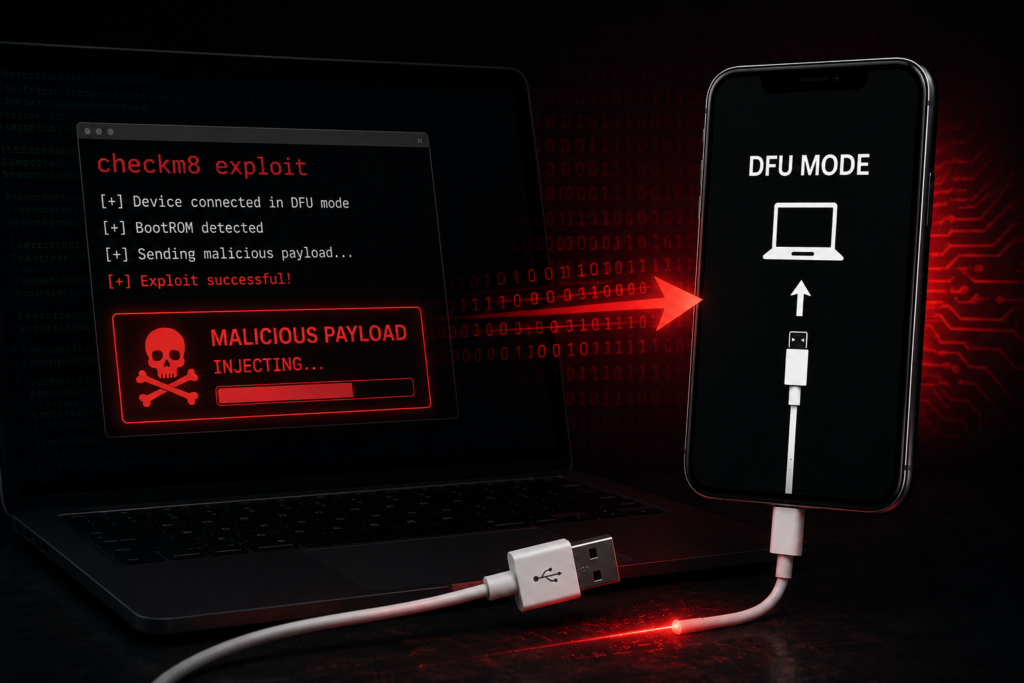
The checkm8 exploit is one of the most important vulnerabilities ever discovered in Apple’s boot architecture.
It permanently changed:
- iPhone jailbreaking
- forensic acquisition
- hardware diagnostics
- activation analysis
- low-level repair workflows
Unlike software vulnerabilities, checkm8 cannot be patched through iOS updates.
Why?
Because it attacks the BootROM — the hardware root of trust.
This article explains:
- what checkm8 is
- how it works internally
- why DFU mode is required
- heap grooming mechanics
- USB memory corruption
- payload execution flow
- real-world technician usage
What is checkm8?
checkm8 is a permanent BootROM exploit discovered by axi0mX in 2019.
It affects Apple devices using:
A5 → A11 chipsets
This includes:
- iPhone 4S
- iPhone 5/5S
- iPhone 6/6 Plus
- iPhone 6S/6S Plus
- iPhone 7/7 Plus
- iPhone 8/8 Plus
- iPhone X
The exploit provides:
- arbitrary code execution
- secure boot bypass
- custom boot environment loading
This makes it one of the most powerful iPhone exploits ever discovered.
Understanding Apple’s Secure Boot Chain
Before understanding checkm8, you need to understand Apple’s boot process.
Boot chain:
BootROM
↓
LLB
↓
iBoot
↓
Kernel
↓
iOS
Each stage cryptographically verifies the next.
This creates the secure chain of trust.
At the root:
BootROM
This is the most important part.
If BootROM is compromised:
Everything after it becomes untrusted.
That is why checkm8 is so powerful.
What is BootROM?
BootROM is the first code executed when an iPhone powers on.
Its responsibilities:
- hardware initialization
- secure boot verification
- DFU mode implementation
- bootloader loading
Key fact:
BootROM is physically burned into silicon.
This means:
It cannot be patched with software.
Only new chips can fix BootROM vulnerabilities.
This is why checkm8 is permanent.
Why checkm8 Uses DFU Mode
DFU mode (Device Firmware Update) is a low-level USB recovery mode.
In DFU:
- iOS is not loaded
- iBoot is not fully active
- BootROM directly handles USB packets
Communication path:
Host PC
↓
USB
↓
BootROM
This direct communication creates the attack surface.
No operating system is involved.
That makes exploitation possible.
The Core Vulnerability Behind checkm8
checkm8 exploits a flaw inside Apple’s USB DFU request parser.
Main concepts involved:
- heap grooming
- memory corruption
- race conditions
- use-after-free behaviors
- object mismanagement
At its core:
BootROM improperly handles specific USB requests.
This creates exploitable memory states.
Stage 1: Entering DFU Mode
The first step is entering DFU.
Once connected:
Vendor ID:
0x05AC
Product ID:
0x1227
This confirms BootROM DFU mode.
At this point:
The device is ready for USB control transfers.
The exploit begins.
Stage 2: Heap Grooming Explained
Heap grooming prepares memory.
Goal:
Create predictable memory allocation patterns.
BootROM dynamically allocates memory for USB operations.
The attacker sends repeated requests:
GET_DESCRIPTOR
DFU_ABORT
DFU_CLRSTATUS
Pattern:
Allocate
Free
Allocate
Free
Example:
Before:
[A][B][C][D]
After:
[A][hole][C][D]
That hole becomes the target location.
Why?
Because the attacker wants future corrupted data placed there.
This improves reliability.
Stage 3: Triggering Memory Corruption
After memory is shaped:
A malformed DFU_DNLOAD request is sent.
Normal:
2048 bytes
Exploit:
larger than expected
Example:
2304+ bytes
BootROM mishandles this data.
Result:
Memory corruption.
Possible targets:
- callback pointers
- object metadata
- linked list structures
- return addresses
This is the main vulnerability trigger.
Stage 4: USB Reset Race Condition
After corruption:
The host forces USB reset.
This is critical.
Why?
Because BootROM begins cleanup.
But memory is already corrupted.
This creates unstable object states.
Example:
Object freed
Pointer still exists
When BootROM reuses it:
Execution may redirect into attacker-controlled memory.
Timing matters heavily here.
This varies by chipset.
Stage 5: Gaining Code Execution
This is the success stage.
Corrupted pointers redirect execution.
The attacker gains control of:
PC (Program Counter)
Now BootROM executes attacker-controlled instructions.
At this point:
The secure boot chain is broken.
Root of trust is compromised.
The device is now under low-level control.
Stage 6: Loading the Second-Stage Payload
After BootROM execution:
A small bootstrap loader is uploaded.
Its job:
- patch secure boot
- initialize environment
- load larger payloads
Common payloads:
PongoOS
Custom iBEC
Ramdisk
Flow:
BootROM
↓
checkm8
↓
Loader
↓
Payload
This creates a custom boot environment.
What Can checkm8 Be Used For?
1. Jailbreaking
Used by:
checkra1n
palera1n
Allows persistent low-level jailbreak access.
2. Ramdisk Booting
Useful for:
- filesystem mounting
- data extraction
- diagnostics
3. Panic Log Analysis
Technicians use ramdisks to collect deeper logs.
Useful for hardware diagnosis.
4. NAND Repair
Used for:
- NAND diagnostics
- storage testing
- repair workflows
5. Activation Analysis
Boot custom environments for activation state inspection.
6. Forensics
Used for:
- device acquisition
- low-level evidence collection
Why checkm8 is Unpatchable
Because BootROM cannot be updated.
It is hardware.
Even if Apple updates:
- iOS
- iBoot
- SEP firmware
BootROM stays vulnerable.
Only newer chips are safe.
Affected:
A5–A11
Not affected:
A12 and newer
That means iPhone X will remain vulnerable forever.
What checkm8 Cannot Do
Important:
checkm8 does NOT automatically:
- remove iCloud locks
- remove passcodes
- decrypt user data
- unlock carriers
It only provides BootROM execution.
Everything else requires separate chains.
Why checkm8 Changed iPhone Security Forever
Before checkm8:
Most jailbreaks were temporary.
Apple patched them.
After checkm8:
The hardware root of trust itself was compromised.
This created permanent exploitability.
That changed:
- iPhone repair workflows
- jailbreaking
- forensic methodologies
- low-level diagnostics
It remains one of the most important Apple vulnerabilities ever discovered.
Frequently Asked Questions (FAQ)
What is checkm8?
checkm8 is a permanent BootROM exploit affecting Apple A5–A11 devices.
Is checkm8 a jailbreak?
No. It is a BootROM exploit used by jailbreaks like checkra1n and palera1n.
Can Apple patch checkm8?
No. BootROM is hardware and cannot be patched by software updates.
Which devices are vulnerable to checkm8?
Devices with A5 through A11 chips.
Does checkm8 remove iCloud lock?
No. It only provides low-level code execution.
Related Links
- How libusb Works with iPhone DFU Mode
- How Ramdisks Work in iPhone Diagnostics
- Panic Log Analysis for iPhone Hardware Repair
- iPhone Recovery Mode vs DFU Mode
Further Reading & References :
1. axi0mX’s original checkm8 disclosure
Best primary source because axi0mX discovered checkm8.
2. checkm8 exploit repository
Original proof-of-concept.
3. checkra1n project
Built on checkm8.
4. palera1n project
5. libusb official documentation
6. USB DFU specification (official)
USB Device Firmware Upgrade Specification
7. Apple Platform Security Guide
Reverse Engineering / Research
8. PongoOS
Useful for:
- post-checkm8 payload execution
- custom boot environment
9. The iPhone Wiki (BootROM/DFU references)
Useful for:
- chip-level boot flow
- DFU PIDs
- BootROM internals